Capture work
Turn exceptions and recommendations into tasks with owners.
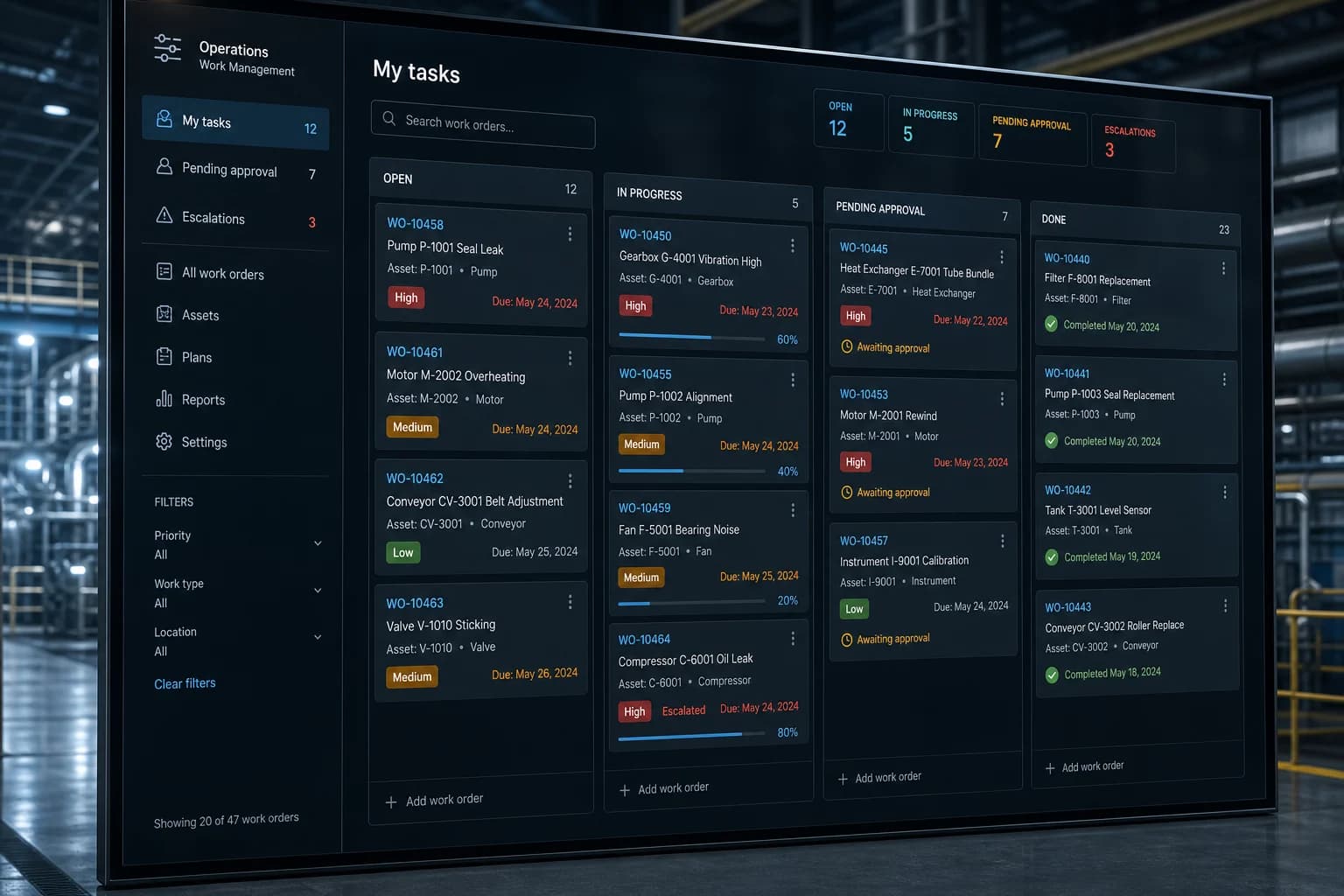

What work needs to happen next?
AI-Powered Business Operations Intelligence
Nexus is meant for operations and management teams who see problems clearly enough, but lose the follow-through across tasks, approvals, customers, and handoffs.
Nexus covers the operational signals and workflows teams need in one connected application.
Source types and integration approaches this product works with, rather than a list of completed connectors.
Common starting wedges where Nexus delivers day-to-day operational value.
An illustrative exchange showing how a nexus question can be answered with the context behind it.
Operations CoordinatorWhich follow-ups from yesterday are still blocking dispatch?
Three open tasks remain: a packaging quality hold, a pick delay in Rack C, and an overdue approval on a corrective action. Each has an owner and a due time attached.
A practical sequence from connection to coordinated follow-up for this application.
Turn exceptions and recommendations into tasks with owners.
Keep handoffs visible across production, quality, and maintenance.
Surface overdue approvals and open actions before they stall.
Carry evidence and status through completion.
Open work becomes part of cross-product answers and priorities.
A model for converting operational intelligence into assigned work, approvals, customer workflows, and follow-up.
Group related work into a priority workflow so operations, compliance, and management teams can close the loop.
Outcome-focused delivery that leans on this product.
Connect condition and runtime signals — from meters, sensors, or existing SCADA and PLC paths — to SOPs, work orders, and recommendations instead of inventing a second control room.
ExploreTurn operational intelligence into coordinated work across teams.
ExploreEach one brings its own operating context, data sources, and evidence expectations.
Textile operations combine production, dyeing, WIP, lots, trolleys, utilities, maintenance, quality, warehouse, buyer compliance, and management reporting.
ExploreFast-moving operations need reliable visibility across production lines, quality, packaging, warehouse, utilities, and dispatch.
ExploreManufacturers need connected visibility across machines, production, maintenance, warehouse movement, quality, and management actions.
ExploreWarehouses and logistics teams need accurate movement, location, dispatch, safety, and exception intelligence.
ExploreStraight answers on what this capability covers, how it connects, and where teams usually begin.
Connects teams, projects, customers, workflows, tasks, approvals, internal operations, and AI automation.
Teams, Projects, Approvals, Customer processes, Docs, Visibility Neo Agent. These are integration approaches and source types rather than connectors that are claimed as complete.
Nexus writes into the shared operational record, so Neo can reason across its data alongside the other products instead of treating it as a separate tool.
Most teams begin with one high-value nexus workflow, connect the sources already on site, and expand once the shared record is useful day to day.
Connect your existing systems — including SCADA and PLC feeds where they already run — with Visibility Bots.
Tell us which operations, SCADA or PLC feeds, documents, or workflows you want to connect first.